
Case Presentation
An 80-year-old right-hand dominant female with past medical history inclusive of hypertension, chronic obstructive pulmonary disease on chronic prednisone, primary adenocarcinoma of right lung on oxygen via nasal cannula 2 liters per minute (LPM) at baseline, hyperlipidemia, iron deficiency anemia, coronary artery disease, and type 2 diabetes mellitus on metformin presented to the emergency department with five weeks of bilateral finger pain. The patient reported that pain was localized to the first, second, and third digits of the bilateral hands and noted associated skin changes to the affected areas, specifically erythema which progressed to skin flaking and ultimately blackness of the left third and right second finger pads. The patient reported being insensate at the fingertips. She denied fever, chills, chest pain, shortness of breath, and upper extremity pain. The patient denied active smoking history and stated that cold exposure did not make the symptoms worse. The patient denied anticoagulation use and self-administered 81 milligrams of aspirin once daily. The patient and her son attributed the findings to daily finger sticks performed for glucose checks with a finger lancet. The history was obtained with a Spanish interpreter at bedside.
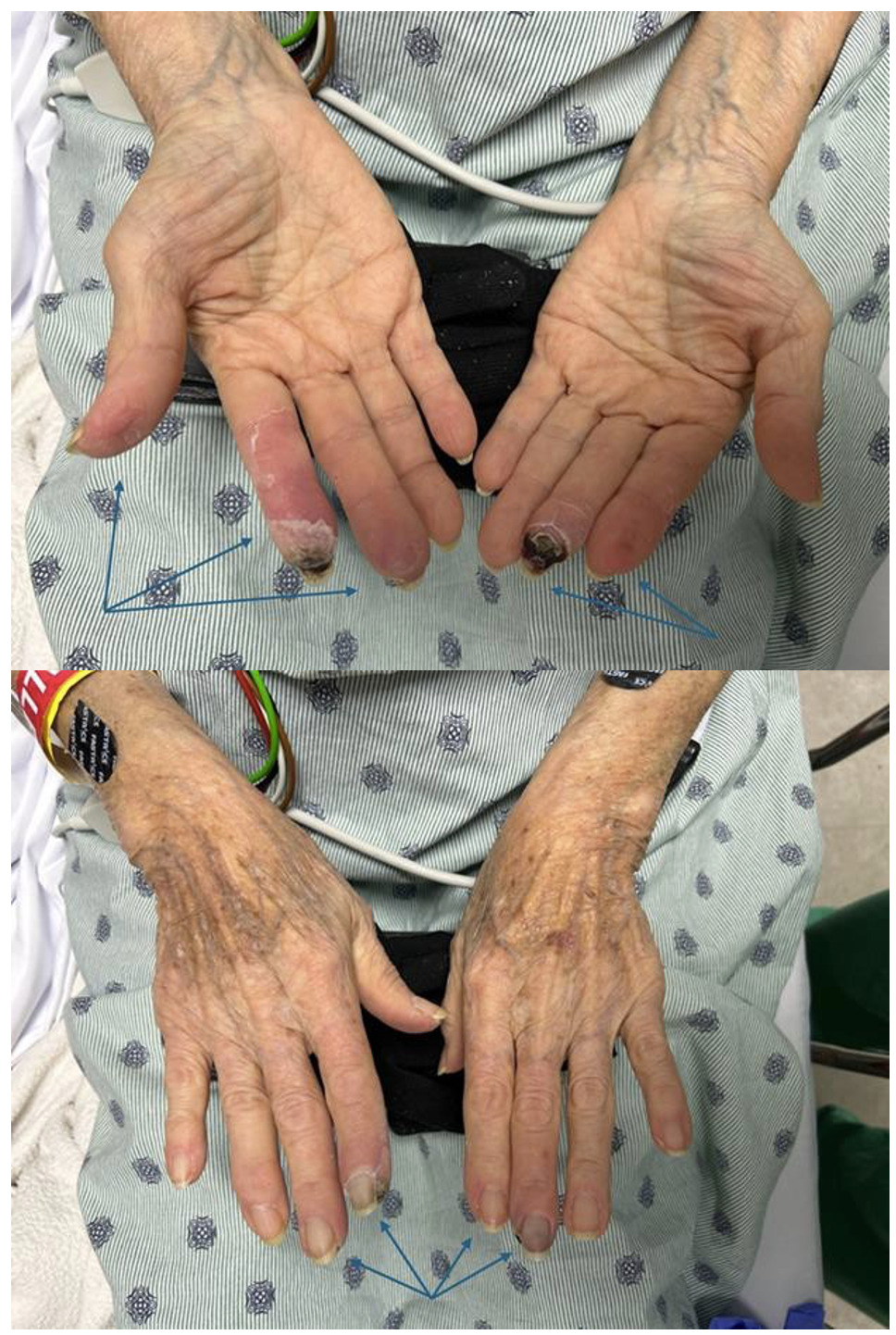
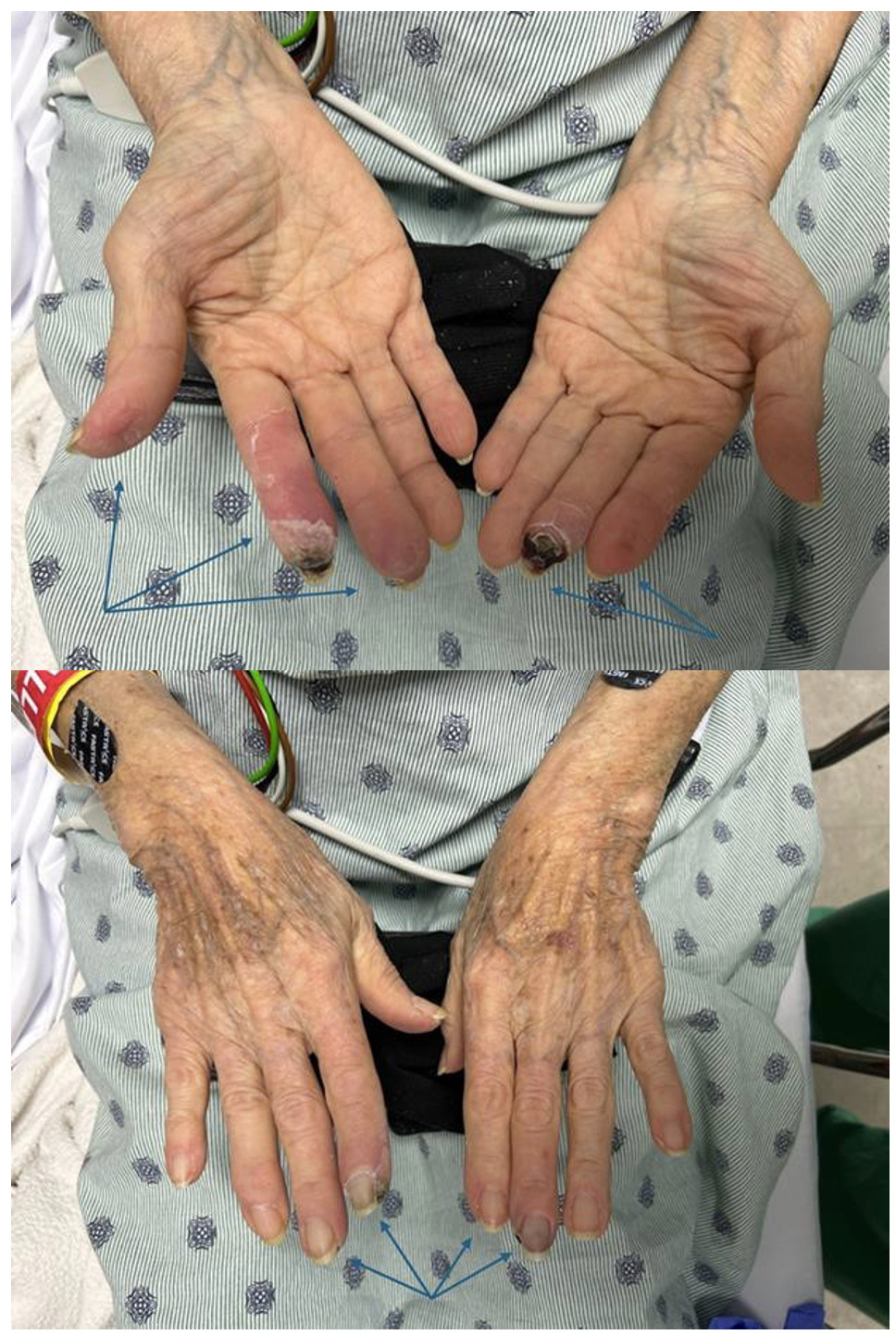
The upper extremities were free of swelling, edema, and tenderness, and range of motion across the shoulder, elbow, and wrist joints was intact bilaterally. The right radial pulse was strong and regular while the left radial pulse was absent to palpation. Bilateral radial pulses were confirmed on doppler. Brachial pulses were strong and regular bilaterally. Erythema was noted along the bilateral first, second, and third digits from the metacarpophalangeal joints to the distal fingertips with dry gangrene noted on the left third and right second finger pads. (Figure 1). Two-point discrimination was absent over the left third and right second finger pads but present across all other digits. Capillary refill was >3 seconds across all fingers of the bilateral hands. The patient was able to flex and extend across all distal and proximal interphalangeal and metacarpophalangeal joints. There was no evidence of circumferential swelling.
Given the distribution of pertinent findings involving the first, second, and third digits of the bilateral hands, the bilateral radial arteries proximal to the deep palmar arch were suspected to be the most likely locations of the culprit lesions. Bilateral duplex arterial ultrasounds of the upper extremities demonstrated 100% occlusion of the right radial artery and greater than 50% occlusion of the left radial artery. The bilateral brachial arteries demonstrated elevated peak systolic velocities reflecting areas of significant stenosis with significantly diminished velocities in the bilateral distal radial arteries. Follow-up computed tomography angiography (CTA) demonstrated non-visualization of the bilateral distal radial arteries at the level of the wrist and slightly above.
Diagnosis – radial artery occlusion
Evaluation of non-iatrogenic radial artery occlusion requires comprehensive vascular imaging with duplex ultrasound as the initial modality, followed by CTA or conventional angiography for detailed anatomic assessment.1 Laboratory workup should exclude autoimmune diseases (antinuclear antibody, rheumatoid factor, complement), hypercoagulable states (antiphospholipid antibodies), and inflammatory markers.2 A cardiac workup including an echocardiogram to assess for septal defects and valvular vegetations and CTA of the aorta may be indicated to rule out proximal embolic sources.3 For suspected Buerger disease, complete serologic evaluation and arteriography of all four limbs is recommended, as asymptomatic limbs may show angiographic abnormalities.4 Treatment is dependent on the underlying etiology. Dry gangrene of the fingertips is suggestive of subacute versus chronic radial artery vascular occlusion. Vascular surgery consultation should be considered based on indications for emergent versus routine revascularization.
Ethics approval
Informed consent was obtained from the patient for the publication of this case report.
Availability of data and material
Data sharing is not applicable to this article as no new data were created or analyzed in this study.
Competing interests
The authors declare that they have no known competing financial interests or personal relationships that could have appeared to influence the work reported in this paper.
Funding
This research did not receive any grants from any funding agency in the public, commercial, or not-for-profit sectors.
Authors’ contributions
All authors contributed substantially to the original and revised draft of the study.
Acknowledgements
None